Montessori toys: stimulate the child's independent learning and motor skills
A Montessori toy is not a pretend toy: it is a real tool, brought down to the child's size , that lets them accomplish a task useful to the whole family. The difference is immediate — a child cutting a real banana for their snack is not playing, they are contributing. Our selection starts with the kitchen, the richest learning ground of everyday life.
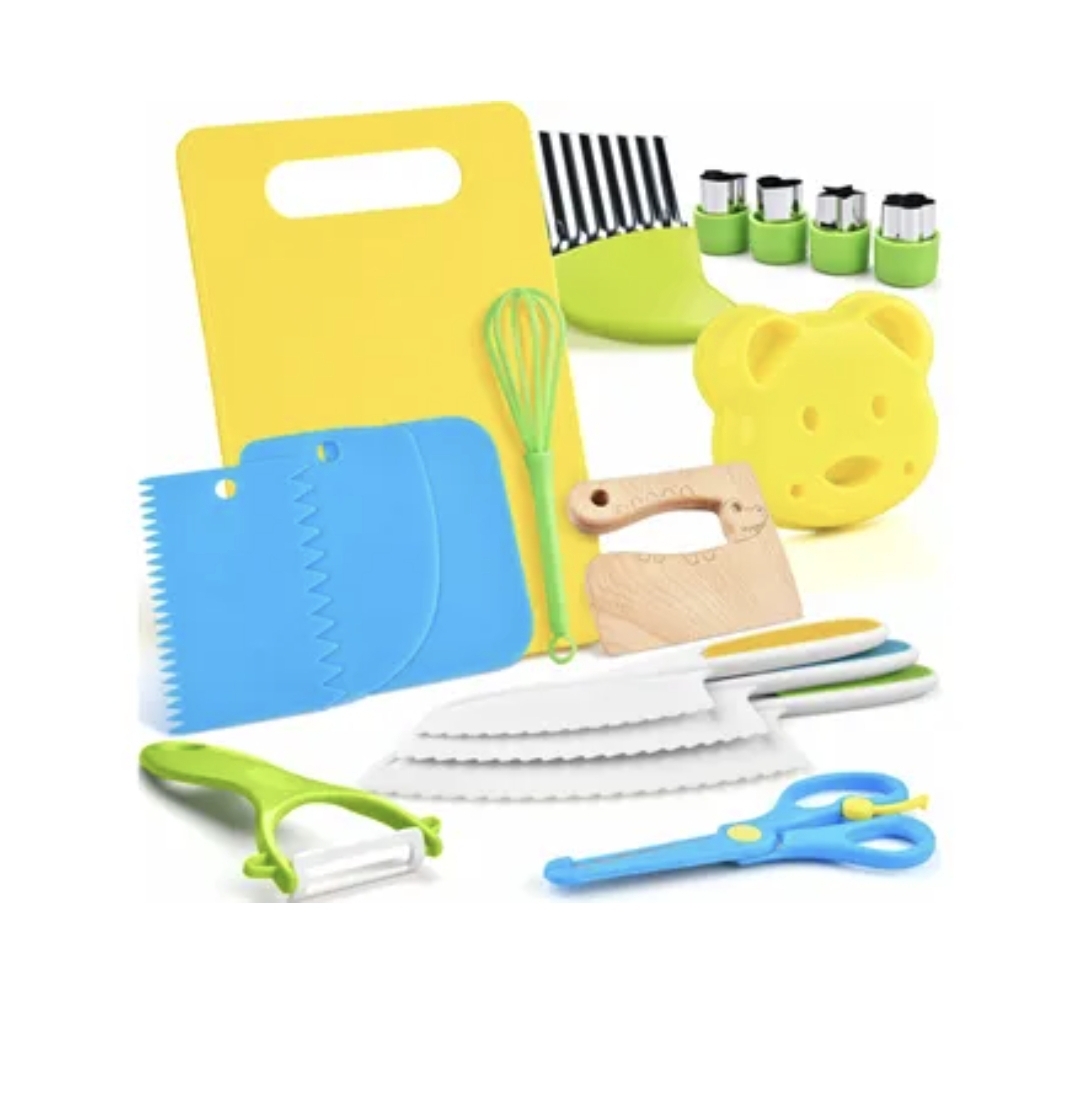
How to choose a Montessori toy well ?
Three criteria come first. First, real functionality: the object must truly cut, peel or pour, otherwise the child pretends instead of learning. Then scale: a handle too long or too thick puts the hand under tension and discourages after two minutes. Finally, graduated safety: the right equipment reduces the risk without removing it, because it is by mastering a tool that really cuts that the child gains confidence. Adult supervision remains the rule, whatever the age.
Select according to the gesture to learn :
- Cooking, cutting, baking → Kids' kitchen set: safety knives, board and baking accessories.
- A first complete, ready-to-use kit → 17-piece kids' kitchen kit: 3 serrated knives of 27, 24.5 and 22 cm, 29 x 19 cm board and cutters.
The criteria to check before buying
| Criterion | Why does it matter ? |
|---|---|
| Real functionality | A utensil that really cuts places the child in a useful task. A purely decorative accessory sends them back to play and teaches nothing. |
| Size and grip | The handle must fit in the whole palm, fingers far from the cutting area. A shortened adult tool is not enough. |
| Materials | Food-grade plastic, solid wood and metal wash by hand and withstand years of repeated use. |
| Genuinely sharp pieces | Some kits mix safe accessories and metal blades. Spot them in advance to know which ones stay under your hand. |
| Care | Hand washing preserves wood and food-grade plastic, where hot cycles dull and warp them. |
Frequently asked questions about Montessori toys
From what age to start ?
The useful benchmark is not age but autonomy: a child able to hold a handle firmly and follow a simple instruction can start, accompanied. Begin on soft foods and broaden as they gain confidence.
What difference from a play set or a pretend toy ?
A play set is for pretending, a Montessori utensil is for doing. The board takes real food, the knives really cut bread or banana, and the result ends up on the family plate. It is this tangible result that anchors the learning.
Is it really safe ?
Suitable equipment sharply limits the risk of cuts compared with a classic kitchen blade, but no functional tool is completely harmless. An adult remains present, and any metal pieces in a kit remain under their control.
Related categories
Frequently asked questions
From what age can Montessori toys be used?
The Montessori approach can begin from birth with sensory mobiles and rattles. Manipulation games (shape sorting, simple puzzles) become relevant around 18 months to 2 years, while practical life activities and concrete mathematics adapt up to age 6.
Why favour wood over plastic?
Wood offers a natural texture and a density that encourage better tactile perception. It is more durable, less slippery and often more aesthetic. It also avoids the sensory overstimulation linked to the lights and sounds of plastic toys, thus encouraging deeper concentration.
How to choose the right toy according to the child's development?
Observe the child's spontaneous interests. If they handle things a lot, opt for stacking towers or puzzles. If they mimic adults, choose practical life games (sink, brooms). The toy must be within their reach and present an achievable challenge to keep their motivation without frustrating them.
Are Montessori toys safe for toddlers?
Yes, provided you choose certified products. Vowenx only offers toys that respect European safety standards (CE), with non-toxic paints and pieces large enough to avoid any choking hazard for children under 3.